View previous newsletters.
Thursday, 17 September 2015
Solent Social Enterprise Place
I'm among the local activists promoting and growing the local social enterprise sector. Between August 2015 and January 2017 I published a monthly update on advice, support, training and finance opportunities. Following a survey of users, it appeared that its impact was not sufficient for me to continue to carry this out as a pro-bono (unpaid) investment in the local social enterprise community. I still continue to provide pro-bono support in other ways and to regional & national initiatives and organisations.
View previous newsletters.
View previous newsletters.


Thursday, 2 July 2015
Co-op Culture
I'm pleased to announce that I have joined Co-op Culture - another organisation through which I can help develop co-operative and community enterprises.
Co-op Culture is a co-operative consortium of co-operative and community advisors, entrepreneurs and enterprises. Our members and associates have a vast and varied experience of supporting co-operative, community and social enterprise to start and grow.
We deliver the following support and services:
We specialise in the following areas:
Community Agriculture. Community Food Enterprise (food, co-ops, processing, retail and wholesale). Community Energy. Housing Co-operatives Community Land Trusts. Co-operative Bakeries. Woodland Social Enterprise and Social Forestry. Co-operative shared workspaces and hackspaces. Transition Enterprise.
Co-op Culture is a co-operative consortium of co-operative and community advisors, entrepreneurs and enterprises. Our members and associates have a vast and varied experience of supporting co-operative, community and social enterprise to start and grow.
We deliver the following support and services:
- Feasibility studies and market planning.
- Business Planning.
- Financial planning.
- Community finance support including drafting community share offers.
- Advice on grant and loan finance.
- Advice on legal and organisational structures.
- Governance audit and advice on governance “health”.
- Facilitated planning for start-up or organisational change.
- Advice on measuring and reporting social impact.
- Delivery of training on all of the above.
We specialise in the following areas:
Community Agriculture. Community Food Enterprise (food, co-ops, processing, retail and wholesale). Community Energy. Housing Co-operatives Community Land Trusts. Co-operative Bakeries. Woodland Social Enterprise and Social Forestry. Co-operative shared workspaces and hackspaces. Transition Enterprise.
Thursday, 12 February 2015
Solent Social Enterprise Place!
Last night I was at a Social Enterprise network event at Southampton Solent University. It was organised by Social Enterprise Link Wessex but I threw myself into spreading the word. After all, a network is only as strong as its members are active and is really owned by those who participate.
We did a quick count up and there were at least 16 social enterprises from across the south of Hampshire (Romsey over to Waterlooville). There was a good mix of established and start-up enterprises with sectors representing including design, care, catering, training and consultancy (we get every where!)
Having agreed some priorities to enable growth of the sector, we all committed to sign up to create Solent Social Enterprise Place. Social Enterprise Place is a scheme promoted by Social Enterprise UK and denotes our commitment to promoting social enterprise in the local economy. Watch this space
We did a quick count up and there were at least 16 social enterprises from across the south of Hampshire (Romsey over to Waterlooville). There was a good mix of established and start-up enterprises with sectors representing including design, care, catering, training and consultancy (we get every where!)
Having agreed some priorities to enable growth of the sector, we all committed to sign up to create Solent Social Enterprise Place. Social Enterprise Place is a scheme promoted by Social Enterprise UK and denotes our commitment to promoting social enterprise in the local economy. Watch this space
Wednesday, 4 February 2015
Show me the money!
 Why you need to get to grips with finances before choosing your legal structure
I often find myself delivering training or advising social enterprises around the issue of legal structures. Everyone wants to get registered as soon as possible, even if they have no plans to trade immediately.
Choosing the right structure is not just about understanding the way you are going to be organised (in terms of governance and ownership) but also about how finance is going to work in the business. Today I am only talking about finance.
All businesses need finance. Social enterprises and co-operatives are no different. Start-up finance for businesses typically comes from investors with a stake or share of ownership in the business, loans and grants. Once the business is up and running this will be supplemented by reinvested profits. Social enterprises tend to avoid investor ownership but there are ways of involving investors in the business without fundamentally altering the purpose of the business.
If you decide on your legal and organisational form before you understand your financing requirements, you may soon regret it. So get the finances sorted early. Even if it is not accurate, having snapshot of how much investment you need and the likely sources is really useful when deciding on a legal structure.
Here's an example: Let's say a community enterprise decides to establish themselves as a Community Interest Company limited by guarantee thinking they will be able to access grant funding to help them raise a deposit to buy a local community building. They also liked the idea of having an asset lock but they didn't want to be constrained from trading or barred from having employees on the Board which could have happened if they registered as a charity. Once they have written their business plan it shows they can generate sufficient profit to pay the cost of a mortgage, but they have been unable to find funding to raise the deposit. Based on comments from local people who would be willing to lend money if they had a say in the business, they realise that their preferred method of raising the deposit would be through a Community Share issue. A Community Interest Company limited by guarantee is unable to issue shares. Even a CIC limted by share would not be able to offer a public Community Share issue as it would have to meet highly expensive regulatory requirements to make a public offer. The facility they require, combined with an asset lock that they want, is only available to a Community Benefit Society. They decide to wind up the CIC because it is quicker and easier to register a new Community Benefit Society than convert the CIC into one. If they had thought through their financing before registering the legal structure they could have saved themselves unnecessary complications and time delays.
Another example: People involved in the business are willing to work as volunteers on the understanding they have a right to a share of the profits. The only problem is, your chosen legal structure does not allow profit distribution so that avenue is closed unless you change the legal structure.
Key questions regarding finance you need to be able to answer before choosing a legal structure include:
- How much investment do we need for start-up costs and cashflow?
- What sources have we identified already, and how much?
- How reliable are these sources?
- What other sources might be available to make up the remainder?
- Are there any restrictions on those sources?
Until you understand how you will finance the business it may be difficult to answer questions suchas these, which you need to consider before deciding on your legal structure:
- Will you distribute profits, and if so to whom and how?
- Do you need a facility to offer shares? Who can own these shares? Should they be withdrawable or transferable shares?
- Who can become a member or Director?
- Is there any relationship between investment and decision making, and what is it?
- Do you want an asset lock of some kind and does it need to be statutory so it cannot be removed?
There is no stock answer to the question "What legal form should we register with?" so to give yourselves an improved chance of having the right structure, do yourself a favour - work out your finance needs first!
Tuesday, 21 October 2014
Free Social Enterprise & Co-operative training programme Eastleigh November 2014
There is a free Social Enterprise
and Co-operative business training programme, starting in Eastleigh on 4th November 2014, organised by my colleagues
over at Social Enterprise Link. I will be delivering a couple of the sessions. See the poster below and contact john@socialenterpriselink.co.uk if you would like to book or for further information.

Remember, remember the 5th of November - Hampshire & IOW Social Enterprise Network relaunches
 |
| Occupy the economy! |
Our friends over at Social Enterprise Link (Wessex) Cooperative CIC have dug up some treasure with which to give our local social enterprise network a boost and the first session is taking place on 5th November. Put away those barrels of gunpowder, we're going to change capitalism by creating a new economy.
I was involved in some of the early discussions and I set out a blue print for meetings that are worth attending because we walk away with business contacts or possibly even sales. From my point of view, that way it will be worth me being there rather than yet another unpaid event I have to be at instead of earning money to pay the bills! Although my suggestion that we run sessions along the lines of co-operative business referral networking (a la Principle Six) was not adopted, I still have hopes for our network.
I would really like to see the re-launched network owned and controlled by actual social enterprises - rather than infrastructure bodies and people who are paid to sit in meetings. The only way this will happen is if we are there, so please do get involved if you are a co-operative, social enterprise, development trust, environmentally focused business, business with a social purpose, trading charity or campaign group with a trading arm or thinking about establishing something like that.
You can get more details of dates etc from http://www.socialenterpriselink.co.uk/course.html#SOCIAL_ENTERPRISE_LINK_and_HIOWSEN_2014
#socent #coops
Monday, 1 September 2014
Free social enterprise & co-operative business training in West Hampshire!
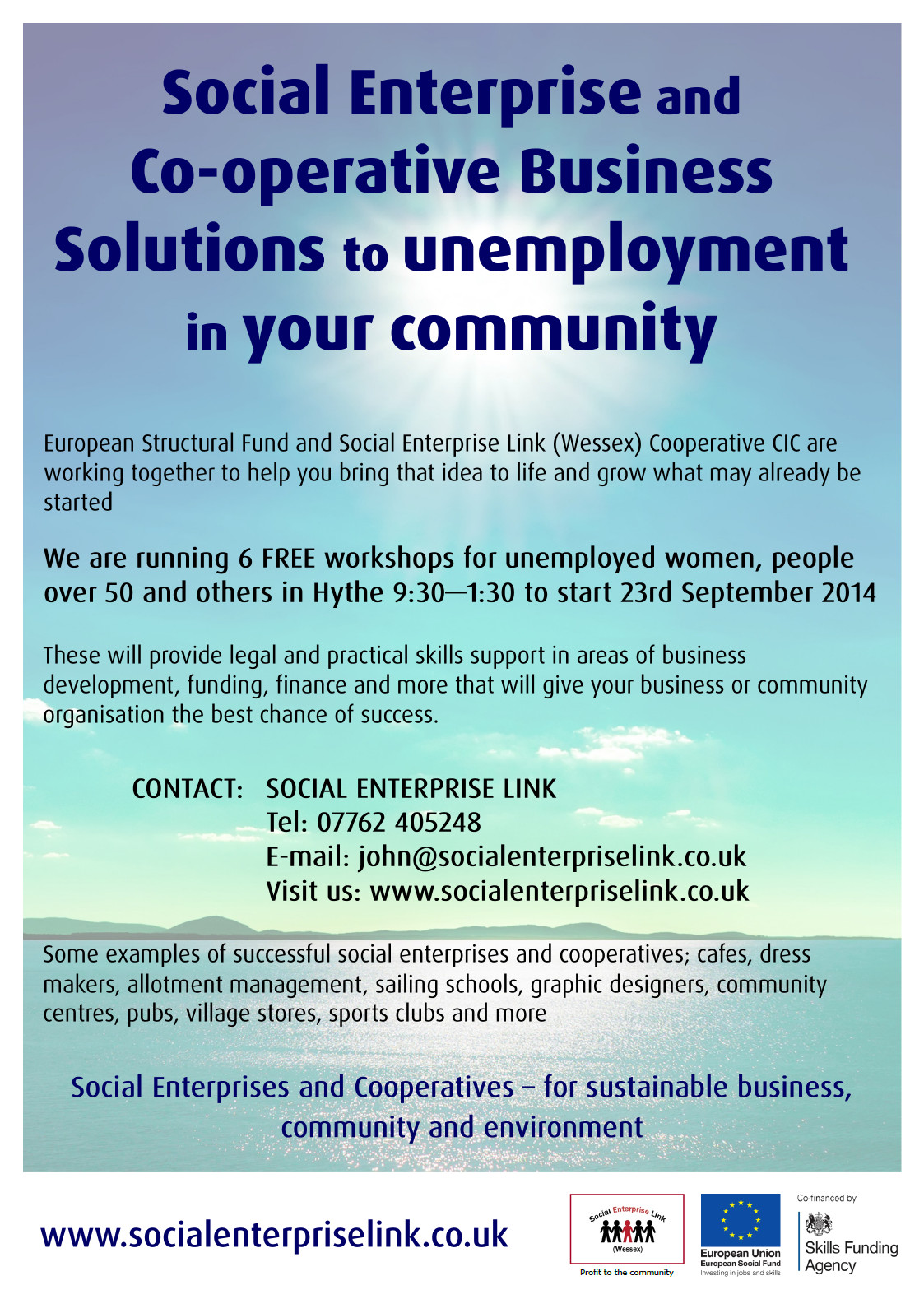
I will be delivering some sessions on the following Social Enterprise and Co-operative business training programme, organised by my colleagues over at Social Enterprise Link. They are running in Ringwood, Eastleigh, Hythe and Romsey - the first programme starting at Hythe on 23rd September 2014. See the posters below and contact john@socialenterpriselink.co.uk if you would like to book or for further information.

Subscribe to:
Posts (Atom)