Last night I was at a Social Enterprise network event at Southampton Solent University. It was organised by Social Enterprise Link Wessex but I threw myself into spreading the word. After all, a network is only as strong as its members are active and is really owned by those who participate.
We did a quick count up and there were at least 16 social enterprises from across the south of Hampshire (Romsey over to Waterlooville). There was a good mix of established and start-up enterprises with sectors representing including design, care, catering, training and consultancy (we get every where!)
Having agreed some priorities to enable growth of the sector, we all committed to sign up to create Solent Social Enterprise Place. Social Enterprise Place is a scheme promoted by Social Enterprise UK and denotes our commitment to promoting social enterprise in the local economy. Watch this space
Thursday, 12 February 2015


Wednesday, 4 February 2015
Show me the money!
 Why you need to get to grips with finances before choosing your legal structure
I often find myself delivering training or advising social enterprises around the issue of legal structures. Everyone wants to get registered as soon as possible, even if they have no plans to trade immediately.
Choosing the right structure is not just about understanding the way you are going to be organised (in terms of governance and ownership) but also about how finance is going to work in the business. Today I am only talking about finance.
All businesses need finance. Social enterprises and co-operatives are no different. Start-up finance for businesses typically comes from investors with a stake or share of ownership in the business, loans and grants. Once the business is up and running this will be supplemented by reinvested profits. Social enterprises tend to avoid investor ownership but there are ways of involving investors in the business without fundamentally altering the purpose of the business.
If you decide on your legal and organisational form before you understand your financing requirements, you may soon regret it. So get the finances sorted early. Even if it is not accurate, having snapshot of how much investment you need and the likely sources is really useful when deciding on a legal structure.
Here's an example: Let's say a community enterprise decides to establish themselves as a Community Interest Company limited by guarantee thinking they will be able to access grant funding to help them raise a deposit to buy a local community building. They also liked the idea of having an asset lock but they didn't want to be constrained from trading or barred from having employees on the Board which could have happened if they registered as a charity. Once they have written their business plan it shows they can generate sufficient profit to pay the cost of a mortgage, but they have been unable to find funding to raise the deposit. Based on comments from local people who would be willing to lend money if they had a say in the business, they realise that their preferred method of raising the deposit would be through a Community Share issue. A Community Interest Company limited by guarantee is unable to issue shares. Even a CIC limted by share would not be able to offer a public Community Share issue as it would have to meet highly expensive regulatory requirements to make a public offer. The facility they require, combined with an asset lock that they want, is only available to a Community Benefit Society. They decide to wind up the CIC because it is quicker and easier to register a new Community Benefit Society than convert the CIC into one. If they had thought through their financing before registering the legal structure they could have saved themselves unnecessary complications and time delays.
Another example: People involved in the business are willing to work as volunteers on the understanding they have a right to a share of the profits. The only problem is, your chosen legal structure does not allow profit distribution so that avenue is closed unless you change the legal structure.
Key questions regarding finance you need to be able to answer before choosing a legal structure include:
- How much investment do we need for start-up costs and cashflow?
- What sources have we identified already, and how much?
- How reliable are these sources?
- What other sources might be available to make up the remainder?
- Are there any restrictions on those sources?
Until you understand how you will finance the business it may be difficult to answer questions suchas these, which you need to consider before deciding on your legal structure:
- Will you distribute profits, and if so to whom and how?
- Do you need a facility to offer shares? Who can own these shares? Should they be withdrawable or transferable shares?
- Who can become a member or Director?
- Is there any relationship between investment and decision making, and what is it?
- Do you want an asset lock of some kind and does it need to be statutory so it cannot be removed?
There is no stock answer to the question "What legal form should we register with?" so to give yourselves an improved chance of having the right structure, do yourself a favour - work out your finance needs first!
Tuesday, 21 October 2014
Free Social Enterprise & Co-operative training programme Eastleigh November 2014
There is a free Social Enterprise
and Co-operative business training programme, starting in Eastleigh on 4th November 2014, organised by my colleagues
over at Social Enterprise Link. I will be delivering a couple of the sessions. See the poster below and contact john@socialenterpriselink.co.uk if you would like to book or for further information.

Remember, remember the 5th of November - Hampshire & IOW Social Enterprise Network relaunches
 |
| Occupy the economy! |
Our friends over at Social Enterprise Link (Wessex) Cooperative CIC have dug up some treasure with which to give our local social enterprise network a boost and the first session is taking place on 5th November. Put away those barrels of gunpowder, we're going to change capitalism by creating a new economy.
I was involved in some of the early discussions and I set out a blue print for meetings that are worth attending because we walk away with business contacts or possibly even sales. From my point of view, that way it will be worth me being there rather than yet another unpaid event I have to be at instead of earning money to pay the bills! Although my suggestion that we run sessions along the lines of co-operative business referral networking (a la Principle Six) was not adopted, I still have hopes for our network.
I would really like to see the re-launched network owned and controlled by actual social enterprises - rather than infrastructure bodies and people who are paid to sit in meetings. The only way this will happen is if we are there, so please do get involved if you are a co-operative, social enterprise, development trust, environmentally focused business, business with a social purpose, trading charity or campaign group with a trading arm or thinking about establishing something like that.
You can get more details of dates etc from http://www.socialenterpriselink.co.uk/course.html#SOCIAL_ENTERPRISE_LINK_and_HIOWSEN_2014
#socent #coops
Monday, 1 September 2014
Free social enterprise & co-operative business training in West Hampshire!
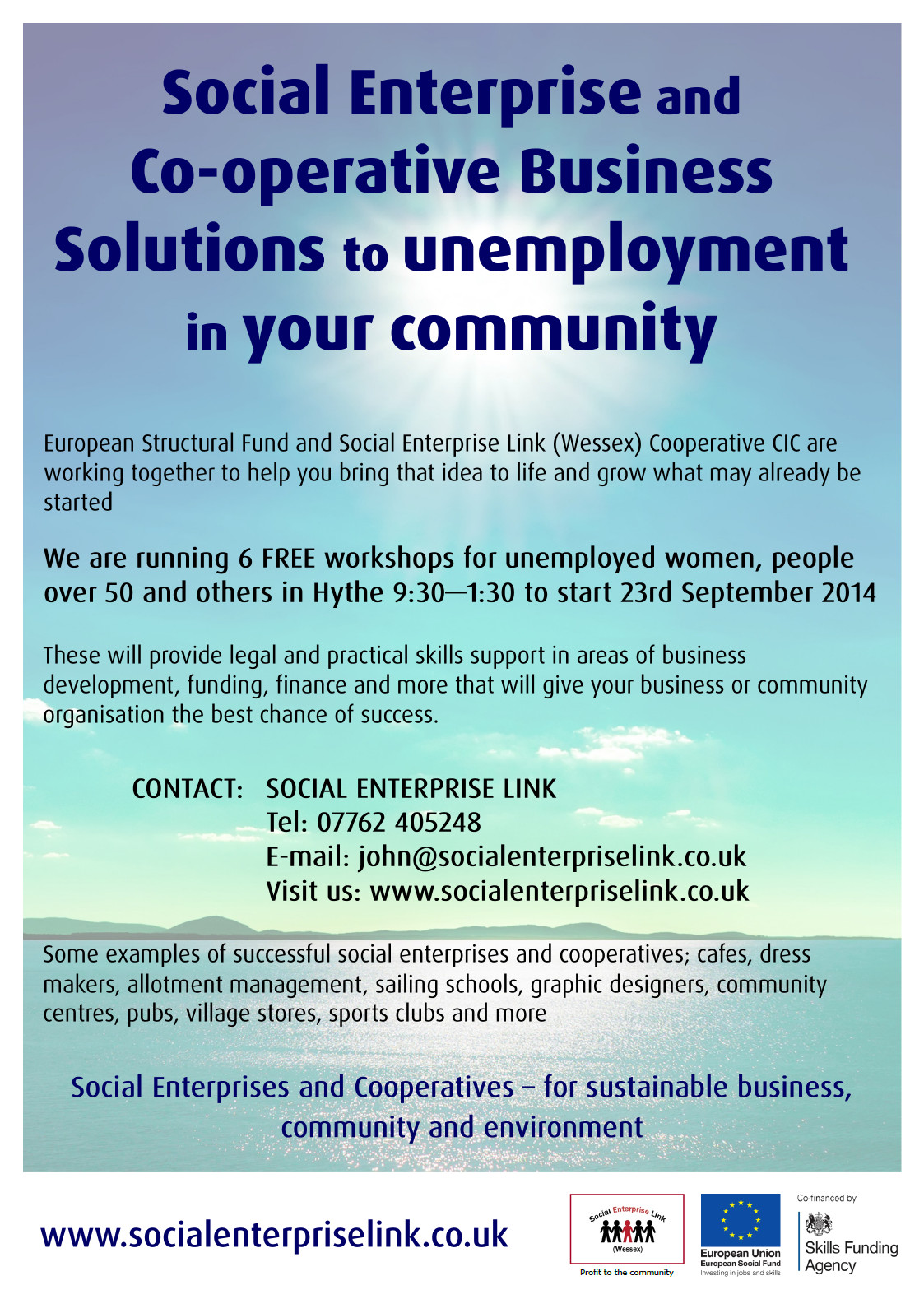
I will be delivering some sessions on the following Social Enterprise and Co-operative business training programme, organised by my colleagues over at Social Enterprise Link. They are running in Ringwood, Eastleigh, Hythe and Romsey - the first programme starting at Hythe on 23rd September 2014. See the posters below and contact john@socialenterpriselink.co.uk if you would like to book or for further information.

Thursday, 5 June 2014
Is it time to widen the focus of co-operative housing and look at new forms of finance ?

What's more, if the property is owned and democratically controlled by those tenants, they will take care of their homes and will seek ways to manage and maintain the property that save money, because it is in their own mutual interest. We are talking about a housing co-operative. It's a no brainer in a country that is suffering from a housing crisis and in which rent is spiraling out of control to satisfy the needs of investors.
However, there is a problem. In order to buy the property you need to have sufficient money to put down as a deposit. This is the primary reason why housing co-operatives are not as prevalent as you would expect given they are a "no-brainer". The problem of accessing capital to lever in finance to purchase the house has come up again and again with potential housing co-op start ups. So maybe we need to have another look at the financing of housing co-ops.
I have been involved as a professional advisor to housing co-operatives since 1998 and was an active member of a 70-member housing co-operative which is a Registered Provider (holding various officer roles including Treasurer) for 12 years. In addition to supporting existing housing co-ops to improve governance or operational matters and to acquire properties, I have also worked with a number of capable pre-start groups who have had their intentions and efforts frustrated.
 Blue sky thinking
I am challenging some of my own views here. I'm not necessarily saying that what I suggest in this piece is how I want the world to be, but if we aim to grow the co-operative elements of the housing sector we need to broaden our horizons beyond our current focus and personal desires. So, beware...blue skies ahead
There has been a tradition of those who speak for the UK Housing Co-op "movement" to focus on public sector housing and public funding for housing co-operatives. They are doing a great job which needs doing, but this is only part of the housing landscape. To make demands of the public purse to support co-operative housing while all political parties are committed to reducing public spend - winning a bigger slice of the cake while the cake is being reduced in overall size - should not be our only tactic. Additionally access to public monies also brings with it the regulation of being a Registered Provider which carries an administrative burden requiring scale and, from my observations, a tendency to move from a radical to a conservative focus. I used to find myself fighting a battle to retain the members' interests over the regulators demands - and winning, I might add.
This means that we have a widely accepted construct in the UK that to be a "housing co-operative" worthy of note you have to a) be of a certain size and operate in a certain way, and b) only provide housing for rent for people in need. So what of those who are not technically in need but want to avail themselves of co-operative housing? There's a gap in the market, and the private rented market is set to boom by all accounts. A case of need, a market, and co-operatives offering member benefit that provides a better offer than the market is fertile ground for co-operative development.
I believe there is room to encourage entrepreneurialism and growth of the co-operative control of housing by being widerin our definition of co-operative housing. To grow co-operative housing we may have to challenge our own sacred cows. There is a difference between what we ought to call "Co-operative housing associations" which is the well developed part of the UK sector and "co-operative housing" meaning housing that has some form of co-operative ownership and/or control.
Moving beyond co-operative housing for renters
In the UK there has been a tendency to downplay any role other than the renter-landlord dynamic. Why is co-ownership ignored? It isn't ignored in the worker and enterprise owned co-operative sectors (notably the agricultural sector). I am a huge fan of common ownership in general and social ownership of housing but we ought to accept exploring some level of co-ownership as an option if we aim to grow the co-operative movement and to use the advantages of mutuality to address housing issues.Some people are interested in partial (or whole) private ownership of properties within a co-operative environment. For instance, I have worked with a group who have potential members willing to sell their homes and invest in a co-operative to provide capital for a development in which they will live. We had to unpick the difference between a mortgage holder who completes their loan and then has a vastly reduced household outgoing over time and the renter who pays rent in perpetuity.
People who have valuable properties may be interested in co-ownership, or may want to invest their equity to enable the creation of housing managed co-operatively in which they can live. But do they get equity growth or just a reasonable return on that equity? And what is reasonable in this context - if the return on equity is not enough to cover the rent? They have swapped a completed or near completed mortgage for a rental property and locked up their equity. It throws up challenges. But we should meet those challenges, not ignore them.
Maybe it is time to blaze a new trail for entry into co-operative housing for people other than renters. My clients are still absorbing and considering the issues this has thrown up and what the final "offer" will be to the different "types" of member - all of whom will still have equal voting rights in how the co-operative is managed.
Co-housing is relatively small but growing in the UK. Some schemes incorporate private ownership and some Community Land Trusts offer private ownership but co-housing and CLTs are meeting specific needs (shared space and land ownership) that not all private owners will be interested in.
Ageing population
We have an ageing population who are asset rich but may require low level support if they are to stay independent in their homes. There could be innovative co-operative solutions to meeting the support needs of home owners and the housing needs of others. One brings equity, the other brings time. Together they create a mutual solution.Leaseholders
What of the co-operativisation of leaseholders? There are many leasholder companies for small blocks of flats that are established as share companies and often run by ex-bankers, stockbrokers or solicitors bringing private sector behaviours of hierarchy. Co-operative principles could be introduced to these organisations and empower all the leaseholders, while providing the wider social benefits a co-operative brings over those of a private mutual."Buy to co-op"
What about "buy to co-op" instead of "buy to let" i.e. instead of establishing housing associations, we establish buy to let entities that just happen to be owned by the people who rent from them (or maybe even allow in investors in a limited capacity, or staff, using a multi-stakeholder model). They could provide a dividend return (profit share)s rather than the model of pre-distribution in the form of lower rents that UK Housing Co-ops offer.Is access to capital the problem?
The biggest barrier to developing co-operative housing I have come across is access to sufficient capital to acquire a mortgage. Some co-ops have used loanstock but this is fairly limited. Withdrawable share capital probably isn't the right approach if you are fully mutual and only want tenants or occupiers controlling the housing, so should we be considering a different approach that enables outside investors to support the needs of tenants without the tenants giving up control over management - a hybrid of the Community Land Trust model and the Housing Co-operative model. Radical Routes have been working to establish a secondary co-op that will own some of the equity in new-start co-ops: Co-operative Principles put into action to grow the movement. Yet the Radical Routes members are a tiny percentage of co-operative housing in the UK. Another innovation could be mutual guarantee schemes (or co-ops mortgaging their existing owned assets to release development capital for other co-ops) which enable new co-ops to establish themselves in the early days when it is not profitability but access to capital that dictates the success, failure or growth rate of a housing co-operative. Rather than ask the government and policy makers to act, I suggest our own movement does something. (Remember those Co-operative Values of self-help and solidarity?)
One innovation that I am certain we need to promote as a movement is inward investment from the co-operative movement into co-operative housing. In particular, we could target pension funds held by large co-operative employers. There must be some mechanism that can be created - even in the current legal framework - which would allow a pension fund to invest in housing developments that just so happen to be co-operatives. Maybe a "co-operative housing fund" that invests bonds or similar - I know nothing about pensions! And if they are start-ups with higher risk then the returns
might be higher in the same way the traditional stock holders approach investments in high risk companies.
This would enable models other than the Registered Provider, which allows for a more diverse sector (lots of small co-ops as well as large ones). Some people I have met have been put off housing co-ops by their experiences in poorly run larger scale co-ops which devalue the individual operating on a tyranny by of the minority basis (like the state socialist approach of the needs of the individual being ignored or undermined for the "greater good"...now intone after me "The greater good"). Yes, part of the answer is to improve larger co-ops, but perhaps we need to question scale and encourage co-ops of all sizes.
Co-operative developers
If we are talking about co-operative involvement in the housing sector (which is what the pre-amble covered), why has the development side been left untouched? Supply is part of the housing economy. Mainstream developers have one goal:shareholder return. What about co-operative developers - either owned by groups of housing co-ops, or as multi-stakeholder co-ops incorporating workers, customer housing co-ops (and maybe even investors) rather than operating purely for profit putting some of their profits into the community by funding CLTs or common ownership housing co-operatives.
Time to innovate?
Should we be innovating to address these capital issues (including more member investment) and move into less traditional areas - growing what for the UK would be a relatively new type of co-op housing? I.e. One that moves beyond the social housing sector and into the private sector.Should our strategic innovation be to move away reliance on state intervention and toward self-responsibility, self-reliance as a movement and promoting Co-operative Principles 6 and 7 in investment away from government back to member users and other investors from the movement? I am not saying ignore state controlled grant funding, but let's not be prisoners of it!
More co-operation!
Friday, 2 May 2014
Got the T-shirt? Invite the community into your community group and spread the work load!
 |
| Got the T-shirt? Does too many jobs sound familiar? |
This blog is primarily intended for community groups who manage or own a community centre or social centre but it applies equally to any community or wide membership based co-operative or social enterprise.
I've worked with many community based organisations over the years, some small unconstituted charities, some of them established as social enterprises, some on the road to trading, and many more considering trading as a means to increase their income. Some have even been constituted as, shock horror, co-operatives. Regardless of legal form or trading status, one common issue I have come across in very community focused organisations is a lack of capacity. How can a mass membership organisation have so few people involved?
The work of, say, managing the community centre bookings, is carried out by a volunteer (yes, usually one!). The Management Committee are all volunteers, and they don't just meet occasionally to make management decisions, they have to carry out all the administration, book-keeping and implementation of those decisions. And the janitorial issues such as ensuring there are tea bags in the cupboard or clearing up after the children's birthday party the day before. Is it any wonder that the prospect of developing a business plan, marketing strategy or just doing anything more than juggle the existing responsibilities is seen as an unrealistic option?
This high volunteer workload can sometimes be combined with an ever diminishing pool of volunteers willing to take on the legal responsibilities of a Company Director or Charity Trustee along with that day to day workload. The vicious circle starts to accelerate and the less volunteers you have, the more work required, the less desirable the job and the smaller the potential pool of people known to existing volunteers. For that is another problem..... unless there is a full recruitment campaign, committee members tend to recruit from the people they already know.
This can mean that any offer of assistance is viewed as a means to fill not only the volunteer capacity problem but also the lack of faces at the Board meeting. Unfortunately this can scare people off. I have one example in mind where the insistence that someone become a Director of a community organisation before they could volunteer resulted in the loss of a highly skilled individual's time and expertise - another organisation with a more accommodating response won out. It even happened to me! My local community centre were embarking on a more enterprising approach and when I got a leaflet through the door, I realised I could be an asset when it came to business planning, feasibility or financial projections. It's what I do. I contacted the email address outlining my skills and experience and told them that I had skills to offer in a focused fashion but couldn't commit to regularly attending a committee on their chosen day. I also made it clear that meetings in the evening were out as I would be alighting from a train after a 12 hour day just as they would start their meeting. The response? Please come to our next committee meeting.
We have the technology to communicate outside of a fully convened meeting - email, telephone, even letter, so why don't we use them? Of course, if there are decisions to be taken then everything must be done according to your constitutional arrangements, but often much of what is done at community organisation committee meetings is concerned with day to day organisation rather than management decisions. We stuff the meetings full of business and never quite get to the end of the agenda before people rush off or drop off!
So, instead of scaring people off, what's the alternative?
 |
| Do you let people climb the "Ladder of Participation" one rung at a time? |
- Do they want to rise through the ranks to become Secretary or Treasurer of the Committee?
- Do they love meetings and committees or would they rather drill their own teeth?
- Are they more interested in putting their time to use differently?
- Can they offer a regular commitment?
- Is this too difficult for them?
- What skills do they have to offer?
- What interests?
- Are there people who are time rich and cash poor or cash rich and time poor?
- Are they already activists in the local community who can promote or support your association as they go about their other activities?
- Supporters/Investors - people with money or goods to donate
- Volunteers -people who want to give time regularly
- Activists - people who are already involved in the community and can help promote your association/centre
- Service Users - people who use the building, events or activities
- Customers - people who hire rooms to offer events either as a business or a community activity
- Specialists - people linked to your community with specialist skills you can use occasionally at reasonable (free?) rates such as tradesmen, solicitors
- Committee/ Board Members, Directors or Trustees - people involved in management decisions at regular meetings and legally responsible for the organisation
Why bother with participation?
Here's a few thoughts. Focus on participation because:- It's the right thing to do: You are a community organisation so you should reflect the community you serve. The more opportunities for involvement there are, the more you can know the community is getting what it wants. The more people that are involved in design of services/activities/facilities the more likely your group is to get it right. Some people call this co-production. But if you go back to basics, its about achieving the purpose of the organisation.
- You have a mandate: When it comes to negotiating with public bodies or funders you can honestly say that the community wants what you propose. And if anyone complains, they can get involved and change things. Don't let the naysayers press their nose up against the window - invite them in to sit in front of the fire and talk it over.
- Market intelligence: If you aim to serve the needs of your community then that is your market. Anything that helps you understand the market's desires, interests or needs gives you a competitive advantage and increases your prospects of being sustainable through earned income.
- It lightens the workload: One of the most obvious reasons, and very pragmatic. Remember the old saying "Many hands make light work?". It's true.
- Participation can open up access to investment: If people have a stake in the success of the organisation because it is meeting their needs, providing employment, helping their neighbours or making the place a better place to live they are more likely to support it - especially if they co-own it with the rest of the community and have a direct say in how it is managed (that would be one member one vote democracy, but can also be more subtle influences by being listened to). The Community Shares programme has shown that communities can access finance from within themselves for the purchase of assets.
- You can unlock potential in your community by engaging more people: For example, some community associations I have worked with have acknowledged that they have difficulties in attracting young people or knowing what they might want. At the same time, I have heard them remark that they struggle to keep their website updated. An obvious solution springs to mind - why not start with young person who can take on some of the responsibilities of social media and use their understanding and approach to try and attract more young people? While solving the problem of lacking time or skills to update the website, you bring a fresh pair of eyes into your organisation.
- Wider ownership provides protection: If the association comes under threat from under-involvement, or external threats such as losing the building or unfavourable terms and conditions, your membership share the responsibility for turning things round and they have something to lose.
I can hear the response to my call to arms already "This is all very well, but how can we do it? Where do we start?" Here are some ideas but you can use whatever works as long as you end up with the same outcome of increasing involvement, sharing responsibility and sharing ownership.
Some ideas
- As an organisation:Open up opportunities.
Break down responsibilities into bite size tasks
Consider the different ways that people can get involved. Don't default to the meeting as the only way of getting involved. Not everyone likes reading minutes and tramping out in the rain to sit in a cold room looking at accounts. One way you can do this is with the tool attached below. Analyse your organisation and write down everything that is done or could be done.
- As an individual committee member:Look at your work load. Is there anything you could pass to someone else. You feel valued - share that feeling! You feel overworked? Share that workload. If you had extra capacity think what you could do with that extra time! You can use the same tool to analyse your individual workload.
- As a local community member:
Find out what you can do. Ask if there is anything the group needs help with.
Think about what you have to offer in terms of skills and experience and make an open offer, then see what happens.
Things may not change immediately but we are creating a virtuous cycle (the opposite of a vicious circle). As things get easier, they get easier to make easy. Momentum starts to carry you in the right direction. Tasks get easier as they are shared among more people. Things get done more quickly or cheaper. Activities are more successful because people are interested in them. Everyone shares in the success.
Resources
If you need to buy in specialist support for your community association in the areas of business planning, marketing, feasibility or viability then please contact me via nathanbsocialenterprise [at] gmail.com
Human Resources planning tool (mentioned above)
Community Ownership capital grants (April-June 2014) Grants for communities seeking to buy assets
My Community Rights - support, advice and funding for community groups managing assets
Cooperantics - co-operative skills for groups to work together effectively, some free resources on website
Community Shares Unit - for communities considering raising finance from the community to buy assets
Subscribe to:
Posts (Atom)